Loading...

Loading...
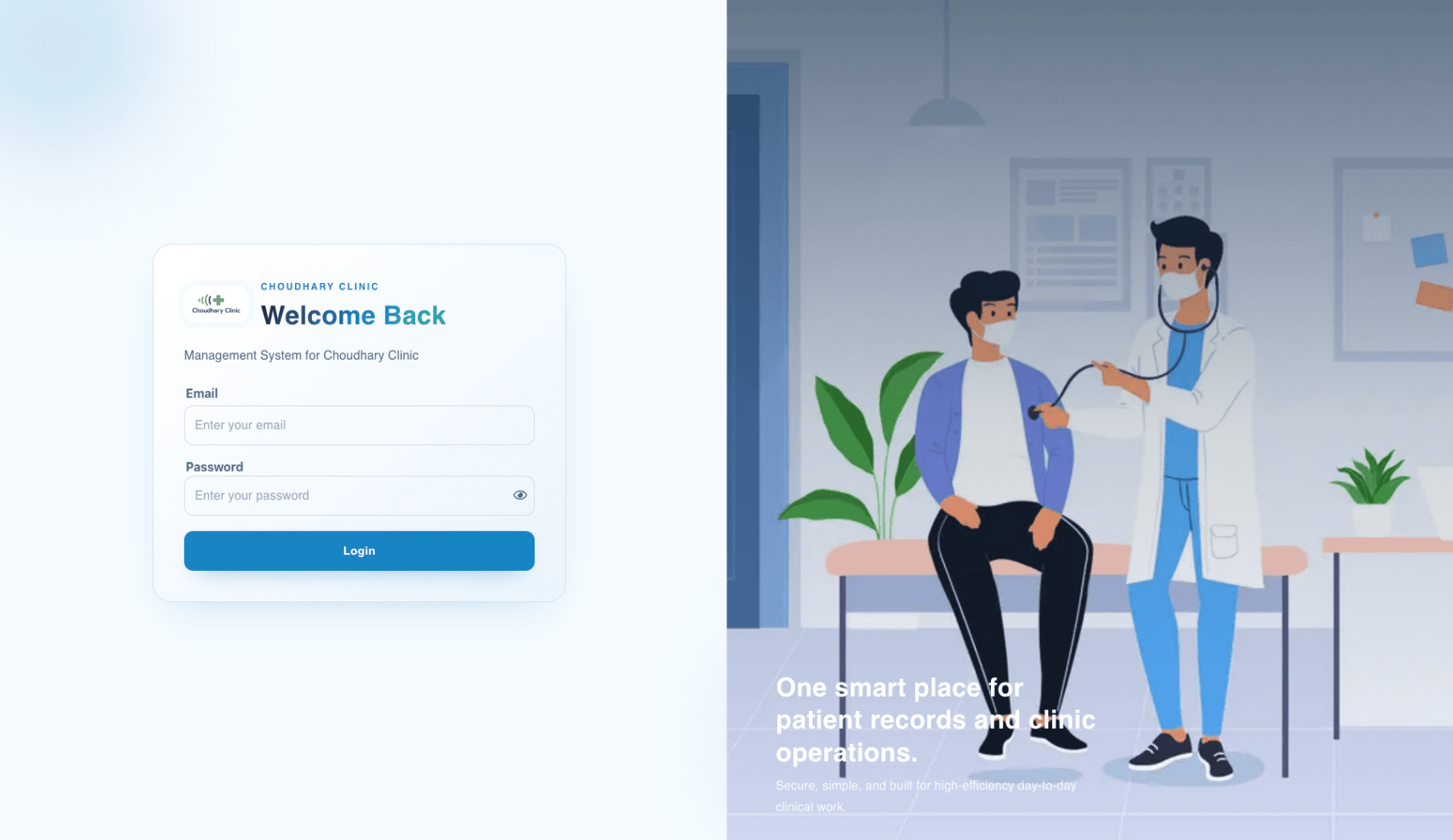
The Clinic & Patient Management System is a full-stack healthcare management solution designed to simplify and digitize everyday clinic operations. Built using the MERN Stack — MongoDB, Express.js, React.js, and Node.js — the platform provides doctors and clinic staff with a centralized system for managing patient records, medical history, prescriptions, and clinic analytics.
The primary goal of the project was to replace traditional, manual record-keeping processes with a secure, scalable, and user-friendly digital platform that improves operational efficiency and provides quick access to critical patient information.
Many clinics rely on paper-based records, spreadsheets, or disconnected systems to manage patient information. These approaches make it difficult to quickly access previous medical records, track patient visits, maintain accurate histories, monitor clinic performance, and generate reports.
Doctors also need to spend valuable time searching through records and manually preparing prescriptions. The lack of centralized information can lead to inefficient workflows and make it difficult for clinic management to gain meaningful insights into daily operations.
The challenge was to develop a system that could centralize patient information, simplify doctor workflows, provide real-time operational insights, and create a scalable foundation for future healthcare features.
A complete Clinic & Patient Management System was developed to provide a centralized digital platform for managing patient and clinic information.
The application enables doctors to securely create, update, view, and manage patient records. Each patient's information can be maintained in one place, while their visit and medical history can be automatically tracked over time.
The system also includes a real-time dashboard that provides an overview of clinic activity, helping doctors and administrators monitor important statistics without manually compiling reports.
The platform provides a complete patient management workflow. Doctors can add new patients, update existing information, view patient profiles, and manage patient records through an intuitive interface.
Patient information is stored in a structured database, allowing authorized users to quickly search for and retrieve records whenever required.
Automatic history tracking is one of the core features of the system. Every new patient interaction can be associated with the patient's existing history, allowing doctors to review previous visits and medical information from a centralized profile.
This makes it easier for doctors to understand a patient's previous records and maintain continuity throughout future visits.
The system includes an interactive dashboard that provides real-time insights into clinic operations.
Doctors and administrators can view key statistics such as total patients, daily visits, and doctor-related information. These insights help provide a quick overview of clinic activity and support better operational decision-making.
Doctors can generate printable prescriptions directly through the platform. This removes the need to manually prepare prescription documents and provides a more organized workflow for creating and printing prescriptions for patients.
The prescription functionality was designed to integrate naturally with the patient management workflow, allowing doctors to access relevant patient information while preparing prescriptions.
The application also provides Excel export functionality for relevant patient and clinic data.
This allows administrators to generate structured reports for analysis, record keeping, and other administrative requirements without manually copying information from the system.
The backend was developed using Node.js and Express.js with a RESTful API architecture. The APIs handle patient management, medical records, dashboard statistics, prescriptions, and other core application operations.
Security, validation, and controlled access were considered throughout the backend architecture to ensure that sensitive patient information is handled appropriately.
The frontend was developed using React.js with a responsive interface that works across different screen sizes.
The user experience was designed around the workflows of doctors and clinic staff, making common tasks such as searching for patients, updating records, reviewing history, and generating prescriptions straightforward and efficient.
MongoDB was used as the primary database because its flexible document-based structure is well suited for managing healthcare-related data and evolving application requirements.
The system follows a clear separation between the React frontend, REST APIs, backend business logic, and database layer. This architecture makes the application easier to maintain and provides a foundation for scaling the platform as the number of patients, doctors, and clinic operations increases.
One of the key challenges was designing a data structure capable of maintaining patient information together with their historical visits and medical records. The system needed to make historical information easily accessible without creating unnecessary complexity in database operations.
Another challenge was building dashboard statistics that could provide useful information while maintaining efficient database performance. Aggregation and optimized database operations were used to retrieve relevant metrics without unnecessarily processing large amounts of patient data.
Data export was another important consideration. Patient information needed to be transformed from database records into a structured Excel format that could be easily used for administrative reporting and analysis.
The completed system successfully transformed core clinic workflows into a centralized digital platform.
Doctors can manage patient records more efficiently, review historical information, generate prescriptions, and access important clinic statistics from a single application.
The system also reduces dependency on manual record keeping, improves accessibility of patient information, and provides a scalable technical foundation for expanding the platform with additional healthcare functionality.
The platform can be further extended with appointment scheduling, role-based access control, multi-clinic management, patient portals, SMS and email notifications, online appointment booking, digital medical reports, advanced analytics, audit logging, mobile applications, and AI-powered healthcare assistance.
The Clinic & Patient Management System demonstrates how modern full-stack technologies can be applied to improve healthcare management workflows.
By combining MongoDB, Express.js, React.js, and Node.js with secure REST APIs, automated medical history tracking, real-time analytics, prescription management, and Excel reporting, the platform provides a reliable and scalable solution for modern clinic operations.
The project successfully bridges the gap between traditional healthcare record management and a modern digital workflow, helping doctors and clinic staff manage patient information more efficiently while creating a strong foundation for future expansion.
Tell us what you're building — we'll help you architect it right the first time.